

Artists of the 60s are often credited with the title of the “Sixties.” To the number of such in the first rows correlate the name of Tokbolat Togusbayev.
In fact, his brushes belong to such paintings as “Steppe Ballada“ (1971-1972), “Song Days” (1987), “Sunny Days of Sanlak” (1990), ” Eastern Interior “ (1990), ” Ayak-Kap. Bride “ (1990). In the period of the artist’s creative activity there was a characteristic universal artistic experimentation.
As art critics note, the artist intuitively subordinates pictorial tools and techniques to the musical-rhythmic pattern of the image. It is not by chance that his best works are called “musical-graphic suites”, and they are created in different genres – subject canvases, landscape, still life, portrait. The names of the works speak already: “Patterns of songs of the steppes”, “Motive”,”Song Days”,”Melody”, “Singing Mountains”. There is a “song element” even in such seemingly “prosaic” works as “Word to the builders” (1973) and “Turksib, 1930″ (1987).
T.Toguzbaev graduated from the Alma-Ata Art School in 1965. His creative development falls on the period of thaw, when in art there is a thirst for change and experiments. In art began “severe style”. In the picturesque symbolism of the young artists of this time romantic aspirations of the era were manifested.
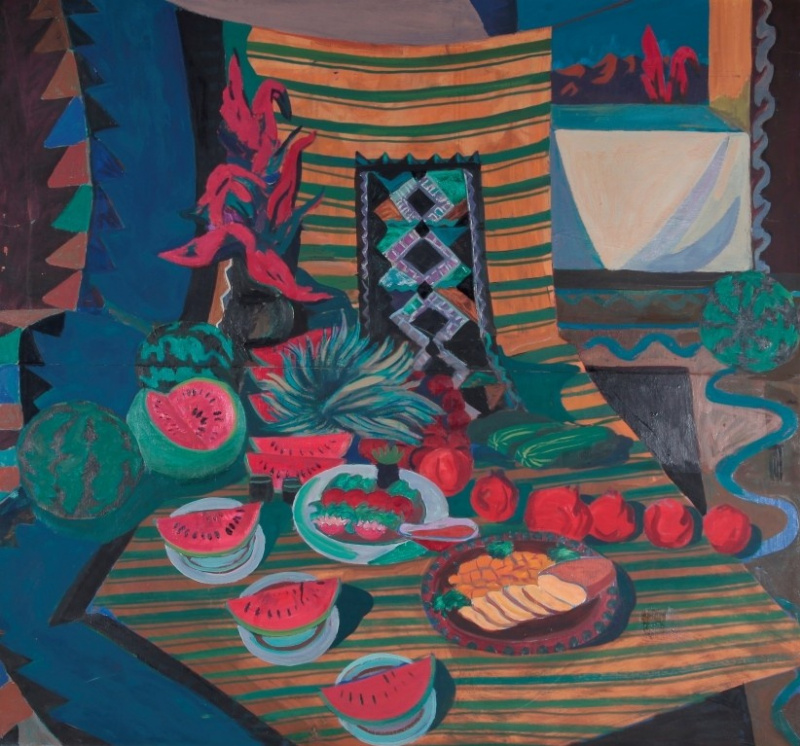
In numerous works, which reflect the traditions of nomadic culture, Tokbolat Togysbayev’s talent as a magnificent colorist and master of composition, who masterfully arranges the space of paintings, is especially powerful. It combines elements of folk arts and crafts, in particular, carpet weaving, with a personal color vision and creates a special festive mood.
Tokbolat Toguzbaev (1940-1996) studied in the workshop of Moldahmet Kenbaev. After graduating from college began to actively exhibit. And he achieved a lot – a member of the Artists’ Union of Kazakhstan, Honored Artist of the Kazakh SSR, he was in demand and officially recognized. His works are represented in the central museums of our country: GMI RK them. A. Kasteev, National Museum of the Republic of Kazakhstan. Already in the era of Perestroika, he painted portraits of three great Kazakh biys – Tole-bi, Ayteke-bi, Kazybek-bi, which are now kept in the museum of the Presidential Center of Culture in Astana.
Olga Baturina, Candidate of Art History, Professor of KazNAA named after T. Zhurgenov, curator of the Zhaukhar Gallery gives her assessment of the work:
“Everything here is poetry and music. Everything in this picture is paradoxical, everything is not what it seems. The space is built conditionally, but filled with air. The paint of the painting is rich and bright, but there is no usual daylight.
Each centimeter of this canvas vibrates, each element is dynamic and stationary at the same time. Everything moves and stays out of time. The figures of people, the movement of birds, animals and even rivers are typified, immersed in a kind of mystical space – beautiful, dear, beloved, but incomprehensible. The lines are round, and the colors sound. The flight line of birds soars upward, and each of the birds is motionless. On the one hand, the whole space of the picture is filled with life – growth, flowering, flight (tall grasses, sunflowers, flowers, trees, birds, rushing horses – it’s just amazing how many heroes there are). On the other hand, everything here is Sufi contemplation. Native land as a heavenly place. Space of serenity and love. Tokbolat Togusbayev himself worked thoughtfully, without haste.Who understands life is not in a hurry. ”



 Saving Art